A firsthand encounter with food insecurity in rural Bangladesh sparked Abira Nowar’s interest in nutrition and shaped her commitment to improving health among disadvantaged communities. Just before beginning her undergraduate studies, she volunteered at a community workshop in a rural area of Bangladesh, where she encountered families facing food insecurity and witnessed the ways limited access to food could affect health.

“I had the opportunity to hear directly from mothers in rural communities about their experiences with food insecurity and its effects on both them and their children,” said Nowar. “That experience inspired me to study nutrition and understand the importance of access to healthy food.”
Originally from Bangladesh, Abira earned both her Bachelor of Science and Master of Science in Nutrition and Food Science from the University of Dhaka. She has since built research experience through collaborations with national and international organizations, including GAIN, UNICEF, the European Union, and government ministries in Bangladesh.
Her work has spanned a range of food and nutrition issues. With the National Heart Foundation of Bangladesh, she contributed to research on ultra-processed foods, front-of-package labeling, and salt-reduction policies. She has also worked on the cost and affordability of healthy diets in Bangladesh through projects with the European Union, food-system transformation with Wageningen University, and the development of healthy dietary patterns with the Food and Agriculture Organization.
In addition to her research, Abira spent more than three years teaching undergraduate and graduate students at the University of Dhaka, an experience that further shaped her passion for research and public health nutrition.
At UNC-Chapel Hill’s Gillings School of Global Public Health, Abira joins the Department of Nutrition under the advisement of Dr. Stephanie Martin and will also collaborate with researchers at the Global Food Research Program (GFRP). She plans to investigate how social and behavioral interventions can improve health outcomes among children and adolescents from disadvantaged communities. She also hopes to expand her methodological toolkit through training in mixed-methods design, as she develops her capacity to lead independent research.
“I’m interested in understanding how social and behavioral interventions can improve health outcomes for children and adolescents in disadvantaged communities,” said Nowar. “I hope this work can help identify approaches that are responsive to the challenges these communities face.”
Abira was drawn to working with Dr. Martin because of her research on social and behavioral interventions to improve nutrition during pregnancy, lactation, and childhood. She was also attracted to GFRP’s collaborative research environment, the breadth of the team’s research, and the opportunity to learn from highly trained mentors working across nutrition and food policy.
Looking ahead, Abira hopes her research can contribute to the development of effective health behavior interventions for children in disadvantaged communities. She hopes her findings can provide evidence to guide interventions that address the nutritional and health challenges faced by children and families with fewer resources.
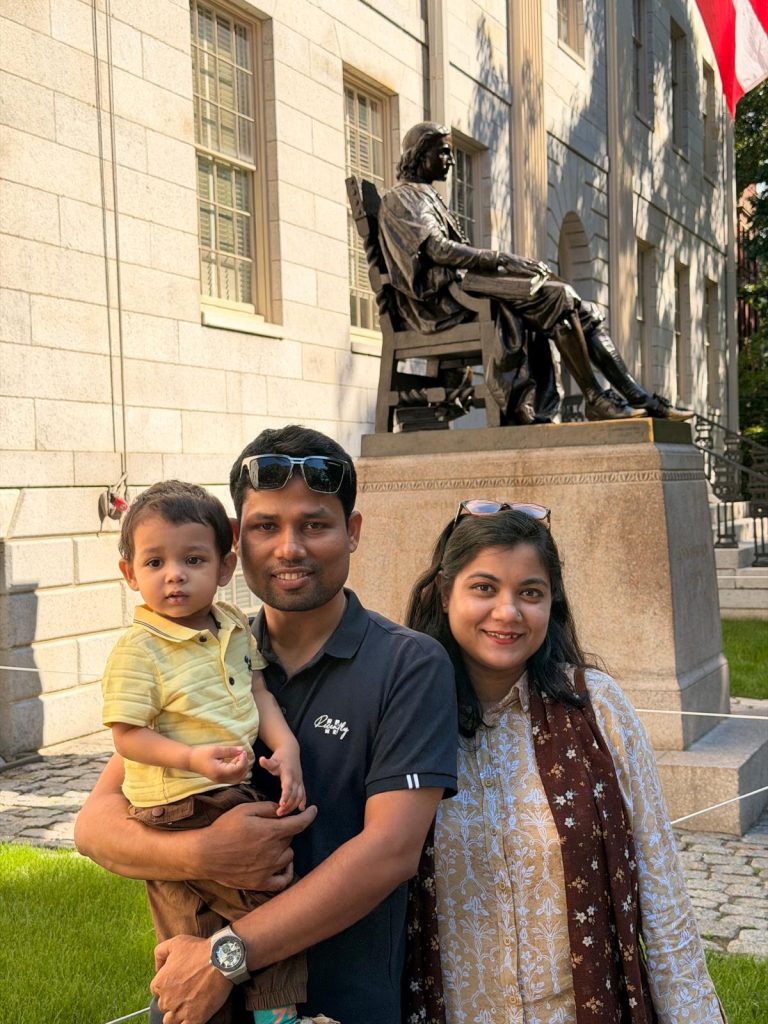
Outside of research, Abira enjoys traveling and spending time with her 18-month-old son, Ariz, whose curiosity and growing personality make this new chapter especially meaningful. She recently moved to Chapel Hill with her husband Saiful and Ariz, and is looking forward to exploring the area, building a community, and discovering new places together as a family.