Despite growing concern about health risks related to high consumption of ultra-processed foods (UPFs), there has not been consensus on how to define UPFs for policy purposes. To meet this need, last year Healthy Eating Research convened an expert panel to develop evidence-informed recommendations for policymakers and advocates interested in advancing policies to limit UPF exposure and consumption at the local, state, and federal levels. Lindsey Smith Taillie, Global Food Research Program co-director and professor and Associate Chair of Academics for the Department of Nutrition at Gillings School of Global Public Health, co-chaired this effort with Jim Krieger, Executive Director at Healthy Food America.
The panel assessed evidence to

- Recommend a definition of UPF suitable for guiding policy development and
- Identify strategic policy options to reduce exposure and consumption of UPFs in the United States.
”It was an honor to work alongside scientists, lawyers, food scientists, health advocacy organizations and our team [at GFRP] to dig into the literature and food supply data to consider every angle,” said Taillie. ”This new guidance offers practical solutions aimed at informing action. The recommendations include:
- A clear scientific definition of ultraprocessed foods,
- A practical, ingredient‑based approach that makes UPFs easier to identify in policy and program settings,
- Guidance for exempting foods that are widely recommended as healthy choices, and
- A menu of policy options.”
Read the executive summary and full technical report at Healthy Eating Research.
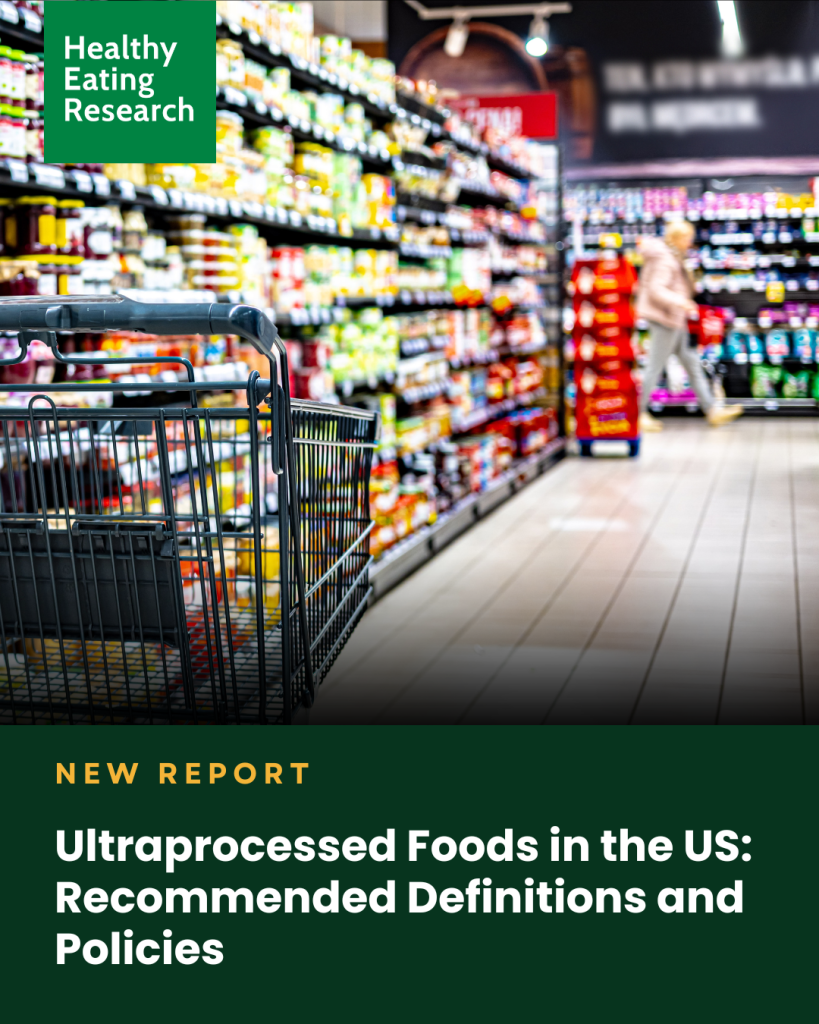
Read the full report at Health Food Research
Learn more about
ultra-processed foods including trends in intake, associated health risks and
environmental impacts,
and policy approaches to
improve the food supply.