A new study in Frontiers in Nutrition has found that adding an ultra-processed food (UPF) warning label to packaged foods changed Chilean parents’ healthfulness perceptions and their intent to purchase, particularly when products had no or few other warning labels.
To better understand how a UPF label may work alongside other nutritional warning labels, researchers from UNC-Chapel Hill and the Institute of Nutrition and Food Technology at the University of Chile developed an online, randomized controlled trial wherein participants were sorted into either:
- A control group that saw products with only Chile’s current warning labels indicating whether they were high in sodium or saturated fat
- A UPF warning label group that saw products with Chile’s high in sodium and saturated fat warning labels plus an additional white octagonal label stating “ultra-processed,” where applicable
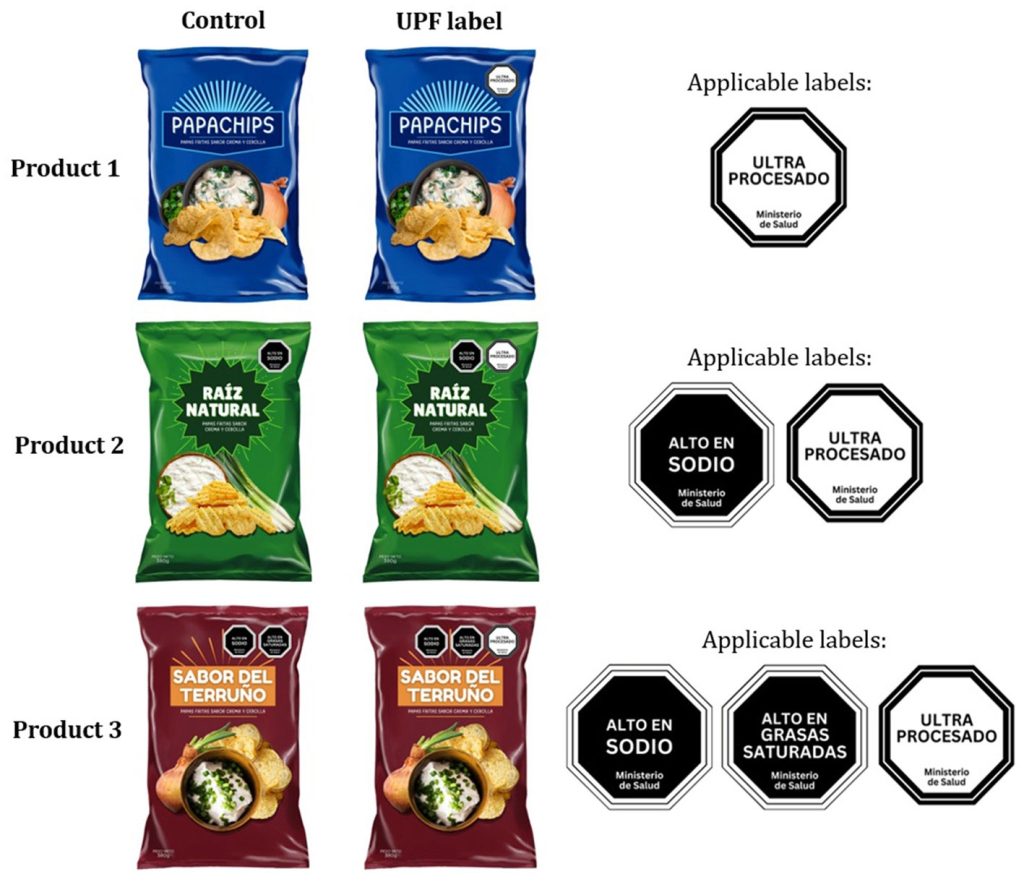
Participants were informed prior to the study about the term “ultra-processed” to further emulate a policy scenario where the government informs consumers about the meaning of a new food label.
During the online survey, more than 3,500 participants rated their purchasing intentions, identified whether a product was ultra-processed, and rated whether they believed a product was healthy. Overall, researchers found the greatest effect on lowering intentions to buy a product when the UPF label was the only label, as opposed to a product high in two nutrients in addition to the UPF label. This suggests that, in the current policy landscape, a UPF label could have the greatest impact on consumer beliefs and behavior when a UPF item carries no or few nutrient labels.

“The biggest contribution of this study is helping us understand, in a context in which nutrient labels already exist, what value UPF labels could add,” said Aline D’angelos Campos, PhD, postdoctoral fellow at the Global Food Research Program at UNC-Chapel Hill and the study’s first author. “In many cases, nutrient and UPF labels will apply to the same products, and our study shows that in these cases, these two types of labels may be redundant to consumers. But if a substantial portion of UPFs do not qualify for nutrient labels — as is the case in Chile and other countries — then UPF labels will be the only label applying many products. Our study suggests that these are the cases in which they have the largest effects. So, in these cases, they could add great value.”
An estimated 40% of UPFs in Chile do not carry any nutrient warning labels, so a new UPF warning label could greatly impact consumer purchasing decisions and overall diet quality in the country. While UPFs are often calorie-dense and high in nutrients of concern (that would be labeled under Chile’s current regulations, i.e., sugar, sodium, and saturated fat), their negative health impacts persist even after accounting for nutrient content. Industrial processes can make foods especially tasteful and easy to digest, leading to excess intake and harm to the microbiome and other systems. Food manufacturers can also reformulate their products to meet existing regulatory nutrient criteria without addressing ingredients or industrial processes that make foods ultra-processed.

Interest in regulating UPFs has been steadily growing and in Chile, where front-of-package nutrient warning labels have been required for the past decade, the country’s senate has been discussing adding a UPF warning label to relevant food packaging.
“In Chile, discussions about the possibility of regulating ultra-processed foods are still at an early stage, with initial conversations taking place in the Senate’s Health Commission,” said Natalia Rebolledo, PhD, assistant professor at the Institute of Nutrition and Food Technology at the University of Chile and the study’s senior author. “Our findings provide timely evidence that can help inform these discussions and support the development of evidence-based policies aimed at improving food environments and protecting public health. While further research is needed, this study represents an important first step in understanding how warning labels for ultra-processed foods may work in the Chilean context.”
This research was supported by Bloomberg Philanthropies as part of the Food Policy Program.
STUDY AUTHORS
Aline D’Angelo Campos
Lindsey Smith Taillie
Marissa G. Hall
Shu Wen Ng
Natalia Rebolledo
Read the full article in Frontiers in Nutrition

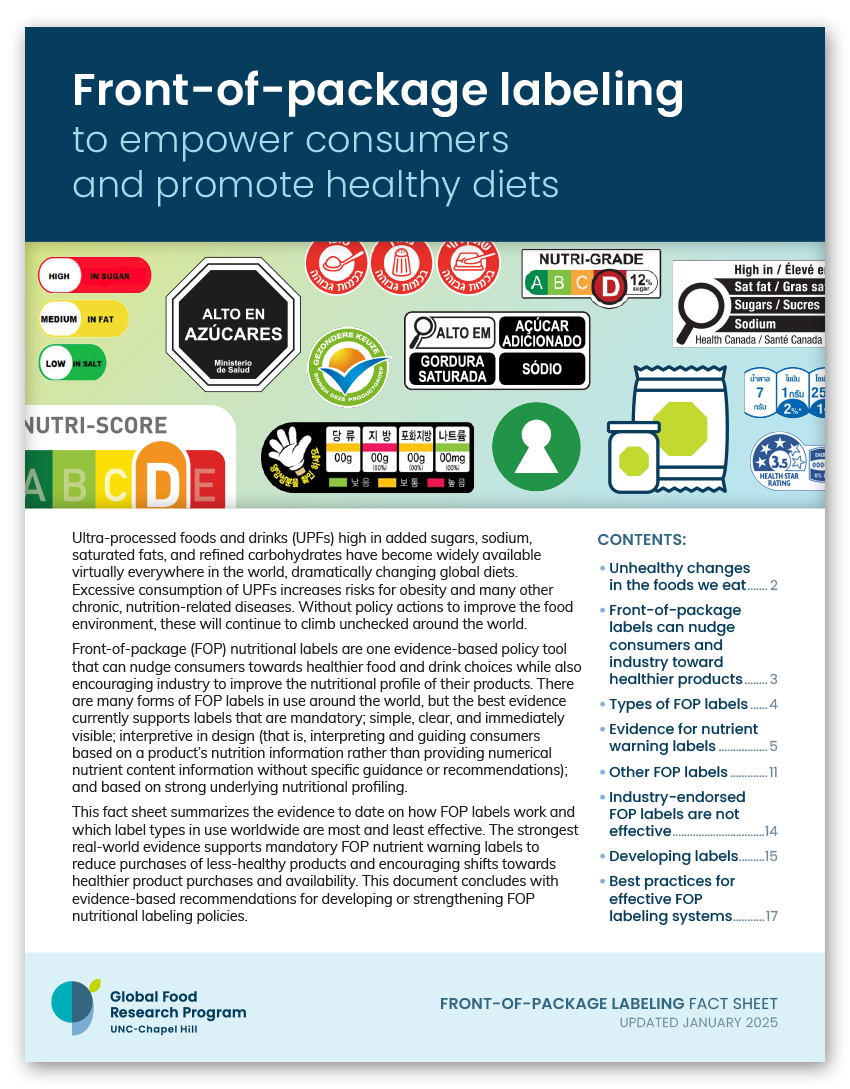
Learn more about front-of-package labeling in our policy fact sheet.
MORE RESEARCH ON FRONT-OF-PACKAGE LABELS:

Chile curbing children’s weight gain with food labels and marketing limits, study finds

Nutrient warning labels yield healthier food supply for Chile
Chileans bought less sugar, salt, saturated fat, and calories at the grocery store after trailblazing warning label law, with high compliance from the food industry